September 11, 2026
What SMERF means in hotel and venue sales
SMERF is Social, Military, Educational, Religious and Fraternal group business. What each letter books, why venues chase it off-peak, and how to sell to it.
SMERF stands for Social, Military, Educational, Religious and Fraternal — the five kinds of group business that are not corporate. It is a segment label hotels and venues use in their sales mix, and the reason it exists is simple: these groups book the dates corporate will not. Weekends, summers, the weeks either side of a holiday. I’m Daniel Pitner, Director of Sales at EventDiagram, twelve-plus years in the event industry, and SMERF is the segment I see venues either quietly live on or entirely overlook. Below is what each letter actually books, why the economics work despite the lower rate, and the operational thing about SMERF that most guides miss. Current as of September 11, 2026.
What each letter books
| Segment | Typical events | When they book | What the room has to do |
|---|---|---|---|
| Social | Weddings, reunions, anniversaries, quinceañeras, bar and bat mitzvahs, milestone birthdays | Weekends, heavily seasonal | Banquet rounds, dance floor, often a ceremony-to-dinner turn |
| Military | Unit reunions, balls, change-of-command, veterans’ associations | Anniversary-driven, fixed dates, long lead | Formal banquet, head table, colour guard, AV for a programme |
| Educational | Alumni weekends, academic conferences, school formals, teacher in-service | Term breaks, summer | Classroom and theater sets, breakouts, then a banquet |
| Religious | Congregational conferences, retreats, youth conventions, holiday events | Summer, weekends, festival calendar | Large theater sessions, breakouts, catering with dietary rules |
| Fraternal | Lodge and service-club conventions, sororities and fraternities, trade associations | Annual, rotating city, long lead | General session plus banquet, exhibit or vendor space |
You will also see SMERFE, which adds Ethnic (cultural associations and community organisations), and SMERF+ or SMERFS, where the extra S is Seniors. They are the same idea with a wider net; nobody agrees on the acronym and it does not matter much, because the segment is defined by behaviour rather than by the letters.
Why venues chase business that pays less
SMERF rates are lower than corporate. Venues pursue it anyway for four structural reasons, and understanding them is the difference between discounting and selling:
- They fill the need periods. Corporate books Tuesday to Thursday, autumn and spring. SMERF books Saturday, July, and the week after Christmas. A rate that looks poor against a Wednesday in October looks excellent against an empty Saturday in July.
- They are date-flexible and price-sensitive, which is a tradeable pair. A corporate group needs a specific week and will pay for it. A reunion committee usually needs “a weekend in the summer” and will move for a better number. That flexibility is worth real money to a revenue manager and should be sold as such: the rate is the price of the date, not a favour.
- They repeat, and they are loyal. An annual convention that rotates through three cities comes back. A congregation that had a good retreat rebooks without an RFP. Acquisition cost falls to near zero by the second cycle, which is where the margin actually lives.
- They bring outside spend. Guest rooms, F&B, AV and parking often total more per attendee than the meeting room rate suggests, particularly for multi-day social and fraternal events where families travel along.
The honest counterweight, because it belongs in any real assessment: SMERF groups are usually planned by volunteers. The person you are selling to may be doing this once, in their own time, alongside a job. Decision cycles are slow, committees change their minds, and the work per booking is higher than the equivalent corporate piece. If your sales team is measured on pieces closed per week, SMERF will look bad on the scorecard and good on the P&L.
The part most SMERF guides miss: it is turn business
Here is the operational reality I would want a venue to take from this page. SMERF events are disproportionately room-turn events. A wedding is a ceremony and then a dinner in the same space. An alumni weekend is a session and then a banquet. A religious conference is a general session, breakouts, and a closing meal. The same four walls have to be two or three different rooms in a day.
That turn is where the money goes. It is labour, it is a hard deadline, and it is the single most common source of a bad night. Two setups of the same room look nothing alike:
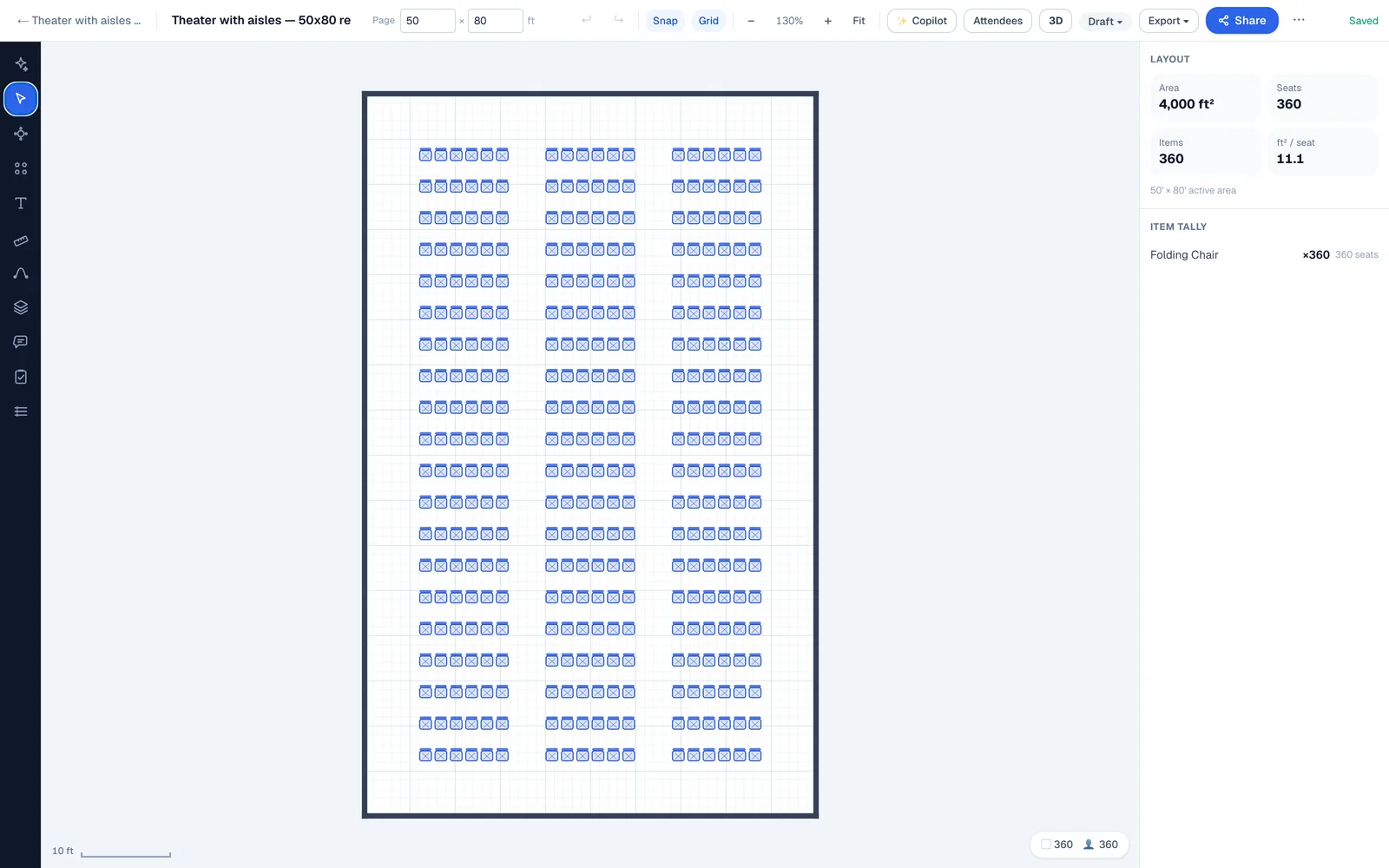
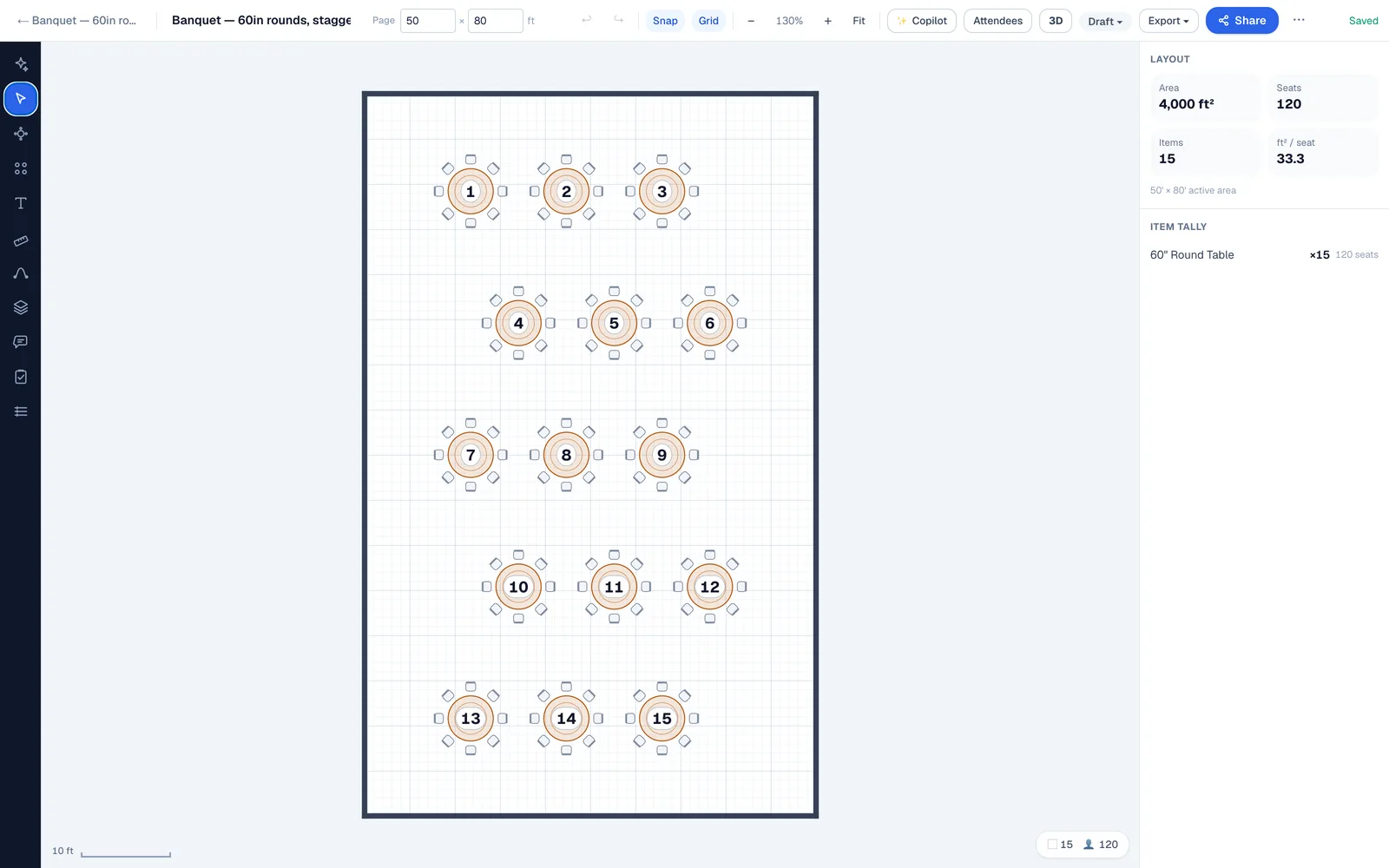
The same 4,000 square foot room: 360 seats as a theater set for the ceremony or general session, 120 as banquet rounds for the dinner. Three hundred and sixty chairs out, fifteen tables and a hundred and twenty chairs in, in the gap between the two — usually while guests are at a cocktail hour somewhere else in your building. Price that turn, staff it, and rehearse it on paper before the day. I have measured both of those sets and the rest in event seating styles.
Selling to SMERF: what actually wins the booking
- Answer fast, and answer with a picture. A volunteer committee comparing three venues remembers the one that showed them their 180 people in the room. A to-scale plan attached to the first reply does more than a rate sheet.
- Quote the turn explicitly. If the event needs the room twice, say what the reset costs and how long it takes, in the proposal. Surprises about the turn are the most common way a good SMERF relationship ends.
- Make the package decision-proof. Committees decide slowly and by consensus. Fewer options, clearly priced, close faster than a menu.
- Ask about dietary requirements at the enquiry, not the BEO. Religious and cultural events frequently have non-negotiable catering rules, and finding out late is expensive for both sides.
- Court the rebook before they leave. Annual groups choose next year’s venue while this year’s is still in their heads. The best time to ask is on site, on the day.
- Be findable. SMERF planners are not procurement professionals; they search like everyone else. Published capacities, real floor plans and dimensions on your site do more for this segment than any RFP platform.
Where we obviously stand
We build EventDiagram, so read this accordingly. None of the segment analysis above needs it. Where the tool is relevant is the two specific things SMERF business demands: a plan you can send in the first reply, and a room you can show set two or three different ways for the same event. Venue plans include unlimited team seats and conversion of your existing floor plans — the detail is on pricing, and the hotels and venues page covers how venues use it in the sales cycle rather than just in operations.
Related reading: the rest of the vocabulary in hotel and event terminology; what a banquet event order should contain in the BEO guide and template; and venue marketing ideas, which starts from the floor plan because that is what planners search for.
Start free. Upgrade when you’re diagramming every week.
The free plan takes one diagram end to end — to real scale, with tables, seating and sharing included.
No credit card required